Multiple Tooth Loss After an Accident: A Step-by-Step Implant Recovery
Dr. Sonia Butta • Impladent® Dental Clinic, Malad West, Mumbai • CBCT-Guided Implant Placement with Staged Bone Grafting • Function and Aesthetics Fully Restored
PATIENT DETAILS
Age: 29 | Gender: Male
Medical History: No systemic diseases, no known drug allergies. Non-smoker, non-diabetic, not on any long-term medication. A 29-year-old working professional who sustained direct facial trauma in a two-wheeler road accident. He was rushed to a trauma centre for emergency stabilisation before being referred for dental evaluation of his fractured and displaced front teeth.
CASE PRESENTATION: Multiple Tooth Loss After a Road Traffic Accident
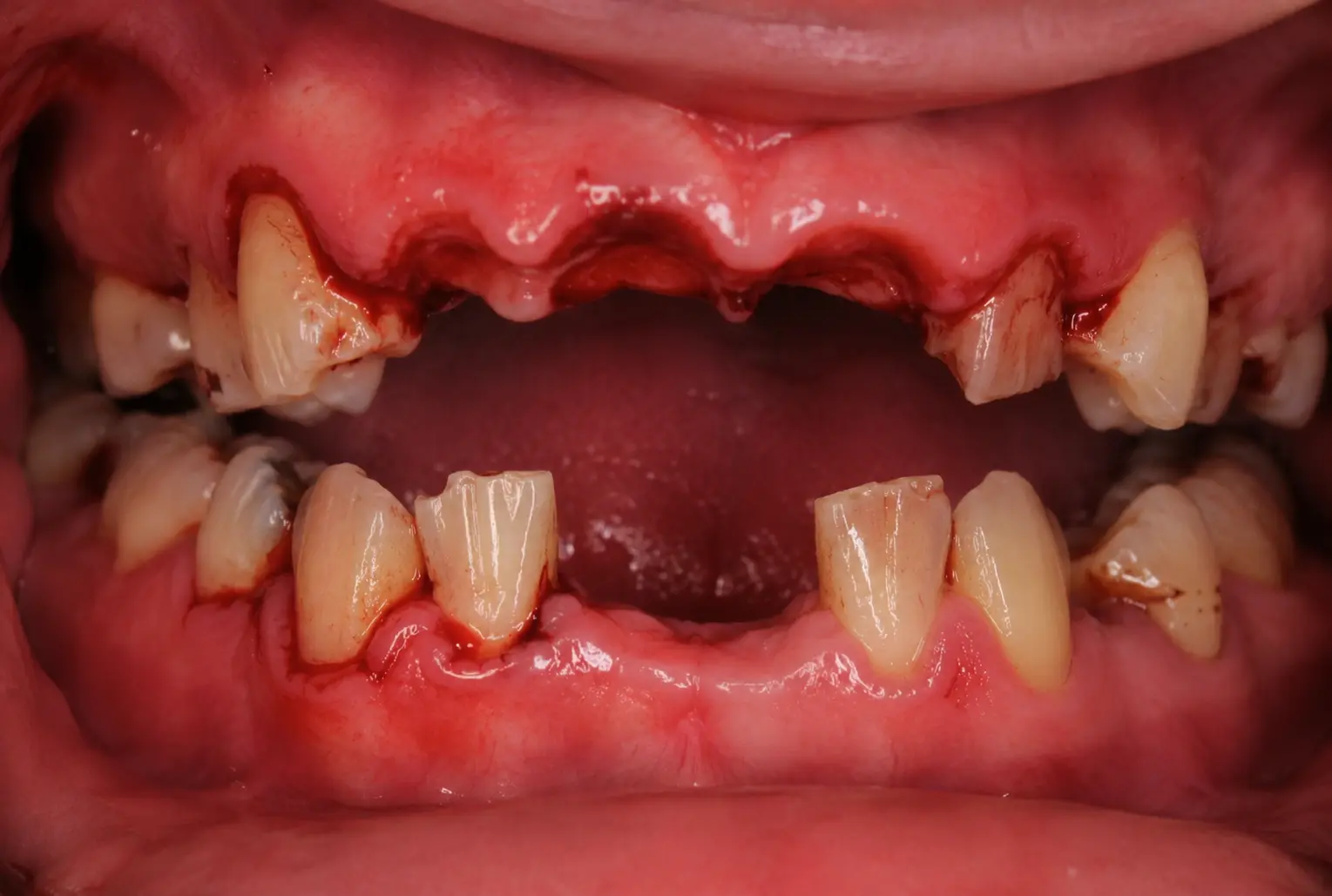
A 29-year-old male patient presented at Impladent® Dental Clinic in Malad West, Mumbai, three days after a road traffic accident that caused direct impact to the lower face. He arrived with swelling of the upper lip, difficulty biting, and visible damage to his front teeth. The trauma team at the hospital had already stabilised him medically and ruled out any jaw fracture, referring him for dental and restorative management.
On clinical and radiographic examination, the patient presented with multiple tooth loss in the upper front region. The right central incisor (11) had been completely avulsed at the accident site and could not be recovered. The left central incisor (21) showed a horizontal root fracture below the gumline, rendering it non-restorable. The left lateral incisor (12) had a similar subgingival fracture with no viable remaining root structure for a crown or post. The right lateral incisor (22) had sustained only enamel chipping and was managed separately with composite bonding.
The patient was evaluated by Dr. Sonia Butta, prosthodontist and implantologist at Impladent®. Following clinical examination and CBCT imaging, three teeth were confirmed as non-restorable and were planned for extraction followed by implant-supported replacement. The treatment plan, including the staged nature of implant recovery after trauma, was explained to the patient in detail, along with realistic timelines for healing and final restoration.
“One second I was riding home from work, the next I was spitting out blood and pieces of my own teeth. I didn’t even want to look in the mirror for two days after — it didn’t feel like my face anymore.” — Patient
Root Canal Treatment Journey: From Acute Infection to a Fully Restored Tooth
| STEP 1 Emergency Dental Assessment | STEP 2 CBCT & Treatment Planning | STEP 3 Extraction & Socket Preservation | STEP 4 Healing & Bone Grafting | STEP 5 Guided Implant Placement | STEP 6 Osseointegration & Provisional Teeth | STEP 7 Final Implant-Supported Restoration |
| Patient examined for fractured, avulsed, and displaced upper front teeth following the accident | CBCT scan confirmed three non-restorable teeth and mapped remaining bone volume | Non-restorable roots extracted atraumatically; sockets grafted to preserve ridge width | Site allowed to heal for several weeks with a removable temporary prosthesis in place | Three implants placed using a digitally guided surgical protocol | Implants left to integrate with the jawbone; a fixed provisional bridge restored appearance meanwhile | Custom ceramic crowns fitted, restoring bite, speech, and a natural smile line |
“Accident-related tooth loss is different from routine extractions. The bone and soft tissue have often been traumatised as well, so the sequencing of grafting, healing, and implant placement has to be planned with extra care to get a stable, natural-looking result.” Dr. Sonia Butta, Impladent® Dental Clinic, Malad West, Mumbai |
The patient journey for multiple tooth loss after trauma: emergency assessment, staged extraction and grafting, guided implant placement, and a fixed ceramic restoration.
DIAGNOSIS
Traumatic multiple tooth loss involving teeth 11, 21, and 12 following blunt facial impact, with associated localised alveolar bone loss at the extraction sites. No jaw fracture. ASA I classification. Confirmed candidate for staged implant-supported fixed restoration following socket preservation and guided bone regeneration.
Traumatic tooth loss occurs when direct impact fractures a tooth root beyond the point of restoration or displaces it entirely from its socket. Unlike decay-related loss, trauma frequently damages the surrounding bone and gum tissue at the same time, which is why sites often need grafting before an implant can be placed predictably. Left unaddressed, multiple tooth loss in the front of the mouth affects biting function, speech, and facial support, and the bone at the site continues to resorb over time. A staged implant protocol allows the site to heal, rebuilds lost bone volume where needed, and then restores both function and appearance with a fixed, natural-looking result.
TREATMENT
- Pre-operative Assessment: Clinical examination, CBCT imaging, and review of the patient’s trauma history and medical fitness
- Atraumatic Extraction: Removal of three non-restorable roots with minimal disturbance to the surrounding bone
- Socket Preservation and Grafting: Bone graft material placed at extraction sites to maintain ridge width and height
- Interim Restoration: Removable, then fixed provisional teeth to maintain appearance and function during healing
- Guided Implant Placement: Three implants positioned using digital surgical guides for precise, nerve-safe placement
- Osseointegration Period: Healing phase allowing implants to fuse with the jawbone
- Final Restoration: Custom ceramic crowns on individual implant abutments, shade-matched to adjacent natural teeth
DETAILED DESCRIPTION OF TREATMENT
Given the trauma history, Dr. Sonia Butta approached this case in clearly staged phases rather than attempting immediate implant placement. The decision to delay implant surgery was based on the localised bone loss at the extraction sites, which needed to be addressed with grafting before implants could be positioned with adequate long-term support.
At the first appointment, the three non-restorable roots were extracted under local anaesthesia using an atraumatic technique to preserve as much of the surrounding bone as possible. Bone graft material was placed into each socket immediately after extraction, and the sites were covered with a resorbable membrane to support regeneration. A removable temporary prosthesis was fitted the same day so the patient did not leave without visible front teeth. Many patients are naturally anxious about implant treatment after an accident, and it helped to walk him through why dental implants aren’t painful once local anaesthesia is administered, even though the sequence of visits takes time.”
Healing was reviewed at regular intervals over the following weeks. Once adequate bone regeneration was confirmed on follow-up imaging, three implants were placed using a digitally guided surgical protocol, positioning each fixture to align with the planned final crown. A fixed provisional bridge was fitted shortly after surgery so the patient could resume normal social and work activities while osseointegration progressed in the background. Cases involving dental implants after trauma often raise questions about overall treatment cost, since grafting adds a stage to the process; this was discussed openly with the patient at the planning appointment so there were no surprises later in treatment.
“With trauma cases, the temptation is to rush to the final crown. We resist that. Letting the graft mature properly before loading the implants is what gives a stable result five and ten years down the line, not just in the first few months.”
Dr. Sonia Butta, Prosthodontist & Implantologist, Impladent® Dental Clinic
Once osseointegration was confirmed, the provisional bridge was removed and individual custom ceramic crowns were fabricated and fitted on the three implants, shade-matched to the patient’s natural teeth for a seamless result.
POST-OPERATIVE ASSESSMENT
| Patient testimonial
“I was in shock after the accident, and losing my front teeth made it worse. Dr. Butta explained every stage clearly, and even during the waiting periods I never felt like I was without a smile. The final result looks completely natural.” |
At the three-month follow-up, radiographic review showed well-integrated implants with stable bone levels at all three sites and no signs of inflammation or crown mobility. The patient remains on a six-month clinical recall schedule. Patients who experience multiple tooth loss alongside other trauma-related dental damage, such as fractured back teeth or bite changes, may also benefit from a broader full mouth rehabilitation assessment to ensure the entire bite is functioning and healing correctly together.
This case reflects a key principle in trauma-related implant dentistry: sequencing matters as much as the implants themselves. Extraction, grafting, healing, and loading each need their own dedicated timeline. When followed carefully, this staged approach to multiple tooth loss predictably restores both function and appearance, even after significant facial trauma.
CONTACT — IMPLADENT® DENTAL CLINIC, MALAD WEST, MUMBAI
| Treating Dentist: | Dr. Sonia Butta, Prosthodontist & Implantologist |
| Co-Specialist: | Dr. Glenn Mascarenhas, Prosthodontist |
| Clinic: | Premier Tower, 201/301, Marve Road, Orlem, Malad West, Mumbai, Maharashtra 400064 |
| Phone: | +91 022 31912633 | +91 022 31424745 |
| Website: | impladent.in | Dental Implants in Malad, Mumbai |
Impladent® is a premium dental clinic in Malad, delivering advanced dental solutions with a commitment to precision, safety, and excellence in patient care.