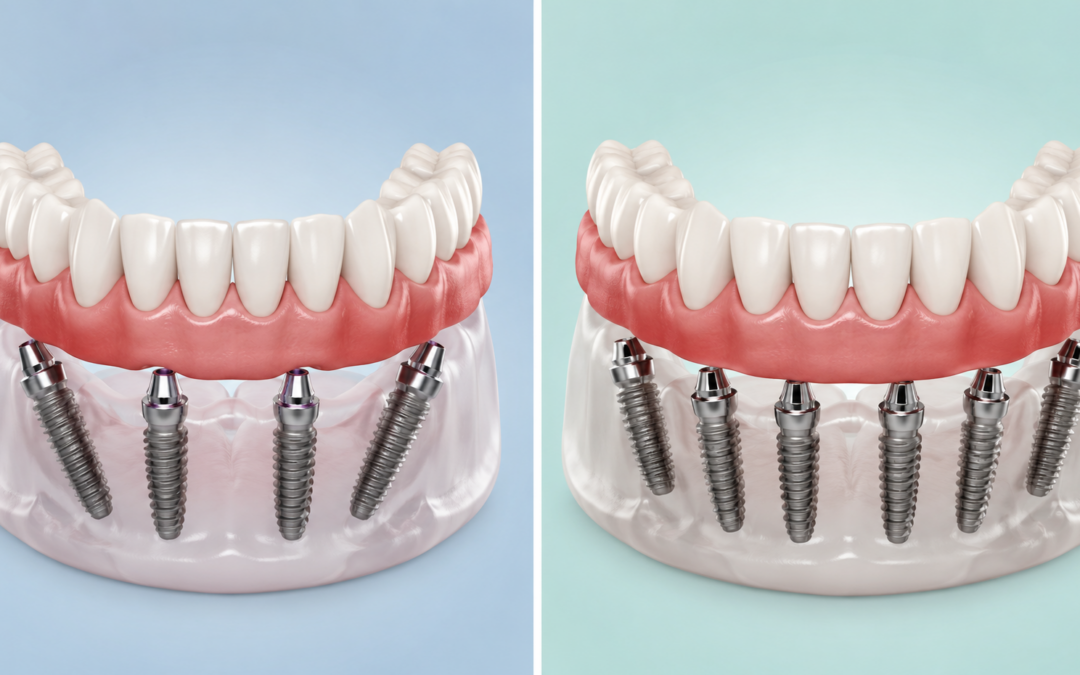
Both All-on-4 and All-on-6 replace a full arch of teeth using fixed implants, and both can be loaded with teeth on the day of surgery. The number refers to how many implants support the prosthesis. Four in one case, six in the other. Neither is automatically the better choice. What determines which one goes in is the patient’s bone volume, bite load, and jaw anatomy, not a general preference for one system over another.
According to Dr. Sonia Butta, Prosthodontist and Implantologist at a leading Dental Clinic in Malad, Mumbai, “All-on-4 works well for most patients. All-on-6 comes into the picture when the bone quality or arch length calls for extra support. It’s a clinical decision, not a preference. The CBCT scan tells you which one the case needs.”
All-on-4 vs All-on-6: What Actually Differs?
The core difference is biomechanical. More implants mean more contact points under the prosthesis, which changes how bite forces are distributed. Here’s how the two systems compare.
Feature | All-on-4 | All-on-6 |
Implants per arch | 4 | 6 |
Bone requirement | Lower, suited for bone loss | Higher, more bone volume needed |
Angled placement | Two rear implants tilted | More upright positioning possible |
Force distribution | Wider spans between implants | More contact points, less span stress |
Bone grafting | Rarely needed | Occasionally required |
Same-day teeth | Yes, in most cases | Yes, in most cases |
All-on-4 uses angled rear implants.
Two front implants sit vertical. Two rear implants are placed at an angle, typically 30 to 45 degrees, to maximise contact with available bone and avoid nerves or the sinus. It’s designed specifically for patients with reduced bone volume. Works well. Survival rates above 98% in clinical studies.
All-on-6 adds two more points of contact.
Six implants allow more upright placement and shorter prosthetic spans between fixtures. That translates to less bending stress on the prosthesis and more load distribution across the arch. For patients with higher bite forces or a longer arch, that extra stability matters.
Bone volume is the deciding factor.
Patients with significant bone loss in the posterior jaw are usually better suited to All-on-4. Its angled design avoids areas of reduced bone without needing a graft first. All-on-6 patients typically need adequate bone across a longer stretch of the arch.
Survival rates are comparable when planned correctly.
Clinical data shows no significant difference in long-term implant survival between the two systems when CBCT planning and surgical protocols are followed precisely. The difference shows up in how each handles bite pressure, not in how well the implants fuse with the jawbone. To understand exactly how All-on-4 is placed and what the process involves, visit our All-on-4 implants page.
What Else Should You Know Before Deciding?
The comparison doesn’t end at implant count. Case complexity, prosthetic design, and the surgeon’s assessment all shape the final recommendation.
Cost differs between the two systems.
All-on-6 typically costs more than All-on-4 because it uses two additional implants and may require more bone preparation. The gap varies by clinic and case complexity. Worth getting a breakdown for both options during consultation.
Maintenance is the same for both.
Once the final prosthesis is in, cleaning and care protocols are identical. Interdental brushes, water flossers, and regular six-monthly reviews apply to both. The implant count doesn’t change what aftercare looks like day to day.
Both work for upper and lower arch.
Neither system is restricted to one jaw. All-on-4 and All-on-6 are used for both upper and lower arch rehabilitation depending on bone availability and bite requirements at each site.
Your case may need a broader treatment plan.
Implant count is only one part of the picture. If the case involves missing teeth across the full arch alongside other dental concerns, a coordinated approach may be needed before implants go in. For cases that go beyond implant selection, our earlier post on full mouth rehabilitation covers when a full treatment plan is the right starting point.
Why Choose Impladent for All-on-4 or All-on-6 Implants in Mumbai?
Dr. Sonia Butta has nearly three decades of clinical experience in implantology and prosthodontics at Impladent®, Malad West. She holds the Master of Clinical Dentistry in Prosthodontics with distinction from King’s College London and is a Fellow of the Indian Society of Oral Implantologists. Her approach to full-arch cases is built on CBCT-guided planning and digital prosthetic design, ensuring the implant count and placement angle are matched to what the patient’s bone and bite actually need. Every case is evaluated individually, with a written treatment plan before any surgery begins.
Dr. Glenn Mascarenhas, founder of Impladent® and also MClinDent qualified from King’s, works alongside Dr. Sonia on complex full-arch cases. Between them, patients have access to both surgical and prosthetic expertise under one roof, covering everything from single implants to full-arch reconstructions.
📞 Call Now: 022 3142 4745
Still unsure whether All-on-4 or All-on-6 is right for you? A CBCT scan gives you the answer
FAQs
Is All-on-4 or All-on-6 better?
Neither is universally better. Bone volume and bite load decide which suits you.
Can I get teeth the same day with All-on-6?
Yes. Both All-on-4 and All-on-6 support same-day provisional teeth in most cases.
Does All-on-6 need bone grafting?
Sometimes. More implants need more bone. A CBCT scan confirms whether grafting is needed.
How long do All-on-4 implants last?
With proper care, All-on-4 implants are designed to last a lifetime.
References
- All-on-4 and All-on-6 Treatment Concept Applied Using Computer-Guided Surgery: PMC: https://pmc.ncbi.nlm.nih.gov/articles/PMC10014524/
- Evaluation of Surgical and Prosthetic Success of All-on-4 Restorations — PMC: https://pmc.ncbi.nlm.nih.gov/articles/PMC8165050/
Disclaimer This content is for educational purposes only. Consult a qualified implantologist for an accurate evaluation and personalised treatment plan.